
This past August, TYDE hosted Click Think Thrive, a convening that brought together researchers, practitioners, community organization leaders, policy experts, and teens themselves to discuss one of the most important questions about young people’s relationship with technology: can we determine what makes some programs designed to support youth’s well-being and mental health when using technology work well, while others have little impact?
Families, educators, and healthcare providers all want to do what’s best for teens and support their mental health. Teens spend a lot of time online, and supporting them during this time is critical, but it is incredibly difficult for anyone outside the field (and even those in the field) to know what programs, headlines, and recommendations to trust. Moreover, media and policymakers have been hyper-focused on preventing harms, for understandable reasons, but there is currently an extreme, fear-based narrative. Teens are on screens, so we need to understand how they can thrive, making intentional choices that help technology work for them, not against them.
The TYDE team invited leaders from across the country to form working groups and evaluate the current evidence on digital fluency programs when young people use cell phones and social media, with an in-person meeting in Charlottesville in late August.

One group, led by Stefanie Sequeira (UVA) and Rachel Hanebutt (Georgetown), with Bethany Teachman (UVA) and UVA undergraduate students Alexandra Buddendeck and Bessie Wang, conducted a systematic review of research on programs that build digital fluency in adolescents. Of more than 500 studies screened, 37 met the criteria for inclusion. The findings will be released as actionable guidance for youth and families, policymakers, educators, healthcare providers, community members, researchers, and funders.
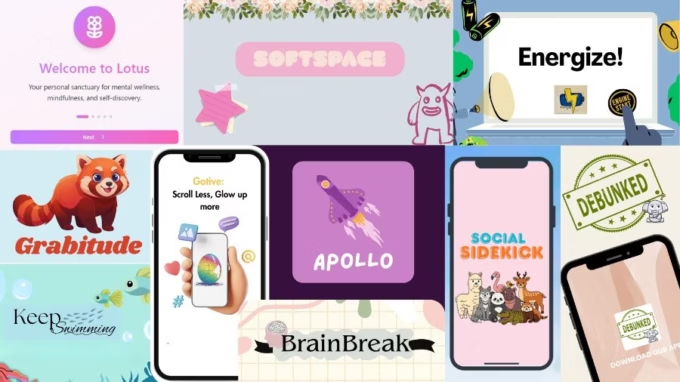
The same group also looked beyond academic journals. Nonprofits, schools, and government agencies are actively creating curricula and programs to strengthen teens’ digital fluency, but many of these have never been studied in peer-reviewed research, leaving a gap between what communities can access and what the evidence shows. To map that gap, the team scanned programs nominated by experts, funded by foundations, or offered through state education and health departments. Eligible programs focused on healthy social media or smartphone use, actively engaged participants, offered original structured content, and served teens ages 10 to 19 directly or through the adults who support them.
A second group convened focus groups to hear what teens themselves think of digital fluency programs. The digital world is an important part of growing up, and expecting teens to abstain from it entirely is unrealistic. For programs to work, they need to be grounded in developmental science and reflect teens’ real experiences and needs.
Teens reviewed a set of widely used digital fluency programs for middle and high school students. Co-facilitated by high school student and TYDE Youth Advisory Board member Seth R. and TYDE Co-Director Nancy Deutsch (UVA), the focus groups explored what teens liked about existing programs, what they felt was missing, and what would make these programs more appealing and effective. The findings from this research will be released as actionable guidelines for program-builders working on youth mental health and technology.
Huge thanks to everyone who contributed their time, expertise, and insight:
- Kate Blocker, Children and Screens
- Alexandra Buddendeck, University of Virginia
- Linda Charmaraman, Wellesley Youth, Media & Wellbeing Research Lab
- Nancy Deutsch, University of Virginia
- Alexandra Evans, independent consultant
- Claudia-Santi Fernandes, Born This Way Foundation
- Leanna Fortunato, American Psychological Association
- Francesca Giannattasio, Born This Way Foundation
- Rachel Hanebutt, Georgetown University
- Vicki Harrison, Stanford University
- Rida Karim, University of Virginia
- Amanda Lenhart, Joan Ganz Cooney Center
- Jacqueline Nesi, Brown University and the Techno Sapiens newsletter
- Seth R., TYDE Youth Advisory Board
- Susan Rivers, iThrive Games
- Stefanie Sequeira, University of Virginia
- Bethany Teachman, University of Virginia
- Emily Weinstein, Center for Digital Thriving at Harvard
- Henry Willis, University of Maryland
We are excited to share results soon!