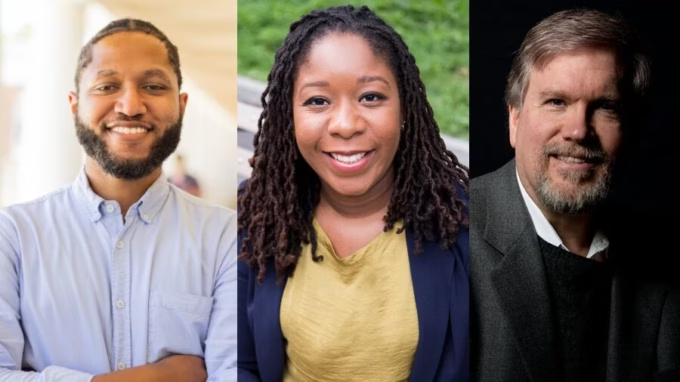

Meet the latest round of seed grant awardees. We’re excited to support the groundbreaking work of these dynamic individuals.
Large Grant Recipients:
Stefanie Sequeira (Psychology) seeks to understand why college aged youth (18-20) experiencing suicidal thoughts and behaviors turn to AI chatbots for support and how those interactions affect their mental health over time. The goal is to combine self-reported experiences with objective chatbot data to inform the design of safer AI systems and develop better clinical guidelines and policy around youth mental health support.
Small Grant Recipients:
Hongru Du (SEAS) aims to build validated measures of young adults’ (ages 18-25) online “information diets” by analyzing a massive dataset of real internet browsing behavior from Comscore, which tracks the desktop and mobile activity of hundreds of thousands of consenting users over 14 years. The project will identify online behaviors that plausibly relate to mental health needs, such as searching for crisis resources, therapy information, or exposure to potentially harmful content, and examine how these patterns differ across demographic subgroups.
John Holbein (Batten) will examine whether personalized AI chatbot conversations can reduce prejudicial attitudes among adolescents (ages 16-19) toward marginalized peers, including transgender, immigrant-origin, and disabled youth, with the goal of improving the peer climate that drives mental health disparities in those groups. The study will also examine whether effects are strongest in communities where marginalized youth face the highest mental health risks, using CDC data as a moderator to situate the work within a mental health equity framework.
Christopher Kuenze (SEHD) pilots “Mind in Motion,” a digital intervention combining mobile mindfulness meditation (via Headspace) and personalized physical activity goal-setting (via Oura Ring wearables) to help young people aged 14-25 who struggle to return to physical activity after ACL reconstruction surgery due to persistent fear of reinjury. The study will address mental health equity by offering a low-cost, remote behavioral health tool for young people with limited access to in-person psychological support during rehabilitation.
Ali Ünlü (SEHD) aims to build a high-quality annotated dataset and train machine learning models to classify youth digital discourse related to weapon carrying, distinguishing between defensive and offensive motivations. Ultimately, the project seeks to translate these insights into a youth-centered prevention and communication framework that integrates digital literacy and coping-skills interventions.
Tianhao Wang (SEAS) will investigate how different AI safety strategies (“guardrails”) affect college students’ mental health help-seeking behaviors, trust, and reliance on AI tools over time, addressing a gap in current research that only evaluates AI safety in short, one-time interactions. The project aims to produce open-source evaluation tools and design guidelines to help universities build safer, more effective AI support tools for students.
Graduate Student Grant Recipients:
Helena Goldbaum (SEHD) will investigate how elementary school-aged children (ages 6-10) perceive digital voice agents (DVAs) that express varying levels of uncertainty, and how those perceptions affect children’s curiosity and views of the DVA’s competence. Findings are expected to advance understanding of how children interact with and learn from socially contingent digital technologies, contributing to broader research on the role of digital tools in child development and education.
Anna Tierney (Psychology) examines how college freshmen’s self-schemas change during the transition to college, and how both in-person and online social interactions shape those changes in real time. The project aims to move beyond static understandings of identity and mental health by capturing how online and offline modern social environments shape self-concept and psychological wellbeing during a critical developmental transition.
Congratulations to all TYDE recipients! Please click here for more information on future grant application cycles.